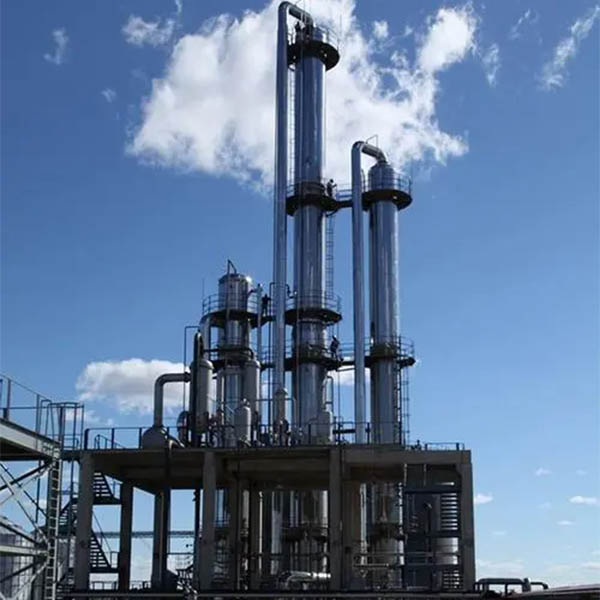
In chemical engineering and industrial process technology, distillation columns are foundational unit operations designed to achieve high-precision separation of multicomponent mixtures based on differences in relative volatility—a thermodynamic property directly correlated with boiling points and vapor pressure. Aligned with international standards (e.g., ISO 6206, TEMA, ASTM E1306), these vertically oriented systems enable the isolation of pure components or fractions from complex mixtures, serving as the backbone of processes in oil refining, petrochemicals, pharmaceuticals, and specialty chemicals. Beyond mere separation, their core purpose extends to optimizing resource utilization, ensuring product quality compliance, and enabling cost-effective large-scale production. This article rigorously delineates the technical purpose, operational principles, key components, system configurations, optimization strategies, and industrial significance of distillation columns, emphasizing their role as irreplaceable tools in modern process engineering.
1. Core Technical Purpose: Separation via Vapor-Liquid Equilibrium
The primary purpose of a
distillation column is to selectively separate components of a mixture into purified fractions by exploiting differences in their relative volatility (α), defined as the ratio of vapor pressures of two components at a given temperature. This separation is governed by vapor-liquid equilibrium (VLE), a thermodynamic principle where a liquid mixture, when heated, forms a vapor phase enriched in more volatile components (lower boiling point, higher α) and a liquid phase enriched in less volatile components (higher boiling point, lower α).
Unlike simple distillation (which achieves only single-stage separation), distillation columns facilitate fractional distillation—a multi-stage process that repeats vaporization-condensation cycles (equivalent to "theoretical plates" or "equilibrium stages") to achieve:
- High-purity fractions (99.9–99.99% for critical applications, e.g., pharmaceutical APIs, petrochemical monomers).
- Selective recovery of target components (e.g., ethylene, propylene from steam-cracked hydrocarbons; ethanol from fermentation broths).
- Removal of impurities (e.g., sulfur compounds from crude oil; water from solvent mixtures) to meet regulatory and product specifications.
This purpose is critical for converting raw materials (e.g., crude oil, biomass, fermentation mixtures) into value-added products, as many industrial feedstocks are inherently complex multicomponent mixtures that require separation to be functional.
2. Operational Principles Underpinning the Purpose
To fulfill its separation purpose, a distillation column leverages three interconnected thermodynamic and engineering principles:
2.1 Vapor-Liquid Contact & Mass Transfer
The column’s internal geometry (trays or packing) provides a large surface area for intimate contact between ascending vapor and descending liquid (reflux). This contact enables mass transfer: volatile components migrate from the liquid phase to the vapor phase, while less volatile components condense back into the liquid phase. Each contact stage (theoretical plate) increases the purity of the vapor and liquid streams, with the number of stages directly determining separation efficiency.
2.2 Temperature Gradient Control
A vertical temperature gradient is maintained within the column (highest at the base, lowest at the top) by the reboiler (heats the bottom liquid) and condenser (cools the overhead vapor). This gradient ensures that each component vaporizes and condenses at its respective boiling point, enabling selective fractionation. For example, in crude oil distillation, naphtha (boiling range 30–200°C) condenses in the upper section, while heavy gas oil (370–500°C) is recovered from the lower section.
2.3 Reflux Optimization
Reflux—condensed overhead vapor returned to the column top—is critical to enhancing separation efficiency. By increasing the liquid-to-vapor ratio (L/V), reflux provides additional liquid for mass transfer, reducing the number of theoretical plates required for a given purity. The reflux ratio (ratio of reflux to distillate) is optimized to balance purity, energy consumption, and throughput.
3. Key Components Enabling the Purpose
Distillation columns are integrated systems of specialized components, each engineered to support the separation purpose:
| Component | Technical Function |
|---------------------|-----------------------------------------------------------------------------------|
| Reboiler | Heats the bottom liquid (bottoms) to partial vaporization, generating the ascending vapor stream. Common types include kettle reboilers (for low-viscosity fluids) and thermosiphon reboilers (for high-throughput applications). |
| Trays/Packing | Facilitate vapor-liquid contact: <br>- Trays (sieve, valve, bubble-cap): Create liquid pools for mass transfer; sieve trays are cost-effective for high throughput, while valve trays offer flexibility for varying loads. <br>- Packing (structured: Mellapak, Sulzer BX; random: Raschig rings): Maximizes surface area; structured packing delivers higher efficiency and lower pressure drop, ideal for vacuum or high-purity applications. |
| Condenser | Cools and condenses the overhead vapor into liquid distillate. Total condensers (for pure distillate) or partial condensers (for vapor-liquid splits) are used, with cooling media (water, refrigerants) selected based on temperature requirements. |
| Reflux Drum | Stores condensed distillate, recycling a portion as reflux to the column top and diverting the remainder as product. Equipped with level controls to maintain a steady reflux ratio. |
| Feed Distributor| Ensures uniform distribution of the feed mixture across the column cross-section, preventing channeling (uneven flow) and maximizing mass transfer efficiency. |
| Side Draws | Extract intermediate fractions at specific column heights (corresponding to boiling point ranges), enabling multi-product separation (e.g., kerosene, diesel from crude oil). |
4. System Configurations Tailored to Industrial Purposes
Distillation columns are configured to match feed properties, separation requirements, and production scale, with four primary configurations:
4.1 Continuous Distillation Columns
- Purpose: For large-scale, steady-state operations requiring continuous feed input and product output (e.g., crude oil refining, ethylene production).
- Technical Specs: Throughput ranges from 10–100,000+ kg/h; operates at constant temperature/pressure; optimized for long-term reliability.
- Application: Refineries processing 100,000+ barrels/day of crude oil to produce gasoline, diesel, and jet fuel.
4.2 Batch Distillation Columns
- Purpose: For small-scale, flexible operations or specialty mixtures (e.g., specialty chemicals, pharmaceutical intermediates) where feed composition varies batch-to-batch.
- Technical Specs: Batch sizes from 10–10,000 kg; sequential product collection (most volatile to least volatile); suitable for low-volume, high-value products.
- Application: Production of high-purity solvents (e.g., anhydrous ethanol for pharmaceutical use) or custom chemical blends.
4.3 Vacuum Distillation Columns
- Purpose: For separating high-boiling-point components (e.g., heavy oils, polymers) or heat-sensitive materials (e.g., vitamins, APIs) that would degrade at atmospheric pressure.
- Technical Specs: Operating pressure 0.01–0.5 atm; reduces boiling points by 50–300°C; equipped with vacuum pumps and leak-tight seals.
- Application: Refining vacuum gas oil (VGO) from crude oil residues; purification of heat-labile pharmaceutical ingredients.
4.4 Specialty Distillation Columns
- Extractive Distillation: Uses a selective solvent to enhance separation of azeotropes (e.g., ethanol-water mixture) or low-relative-volatility mixtures.
- Azeotropic Distillation: Adds an entrainer to break azeotropes (e.g., benzene as entrainer for ethanol-water separation).
- Dividing-Wall Columns (DWC): Integrates two separation stages into a single column, reducing energy consumption by 20–30% and footprint by 40–50%.
5. Process Optimization: Maximizing the Column’s Purpose
To fully realize the distillation column’s separation purpose, optimization focuses on efficiency, cost, and sustainability—key priorities in modern process engineering:
5.1 Energy Efficiency Optimization
- Heat Integration: Recover waste heat from condensers to preheat feed or power reboilers (via pinch analysis), reducing energy consumption by 20–40%.
- Reflux Ratio Optimization: Minimize reflux ratio while maintaining purity (e.g., using Aspen Plus or HTRI software to model VLE and determine optimal L/V).
- Heat Pump Distillation: Recycle condenser heat to reboilers, cutting energy use by 30–50% for low-temperature separations.
5.2 Design Optimization
- Internal Component Selection: Choose trays vs. packing based on feed viscosity, fouling tendency, and efficiency requirements (e.g., structured packing for high-purity, low-pressure-drop applications).
- Column Sizing: Optimize diameter (to handle vapor/liquid flow rates) and height (to accommodate required theoretical plates), balancing capital cost and performance.
- Material Selection: Use corrosion-resistant alloys (Hastelloy, titanium) for acidic/alkaline feeds; glass-lined or stainless steel for high-purity applications (e.g., pharmaceuticals).
5.3 Advanced Control Systems
- Model Predictive Control (MPC): Real-time adjustment of temperature, pressure, and flow rates to maintain product purity during feed composition fluctuations.
- Online Monitoring: Deploy sensors for vapor/liquid composition (e.g., gas chromatography, Raman spectroscopy) and process analytics to detect deviations early.
6. Industrial Significance: Why the Purpose Matters
Distillation columns are irreplaceable in industrial processes due to their unique ability to meet three critical objectives:
6.1 Purity & Regulatory Compliance
- Ensure products meet strict industry standards (e.g., API standards for fuels, USP standards for pharmaceuticals) with purity levels up to 99.99%+.
- Enable compliance with environmental regulations (e.g., EPA Clean Air Act, EU REACH) by removing harmful impurities (e.g., sulfur, heavy metals) from emissions and waste streams.
6.2 Cost-Effectiveness & Scalability
- Offer lower operational costs than alternative separation technologies (e.g., extraction, crystallization) for high-volume applications, with economies of scale reducing cost per unit of product.
- Scale seamlessly from lab-scale (1–10 kg/h) to industrial-scale (100,000+ kg/h) without compromising separation efficiency.
6.3 Versatility & Adaptability
- Handle diverse feed mixtures: aqueous solutions, organic solvents, hydrocarbons, polymers, and slurries (with suspended solids <5%).
- Adapt to changing market demands (e.g., switching from gasoline to diesel production in refineries) via process parameter adjustments.