Working Principles of Stirred Tank Reactors
A stirred tank reactor (STR), also referred to as a stirred vessel, operates on the core principle of mechanical agitation-driven mass transfer, heat transfer and reaction kinetics optimization. Its fundamental function is to use a rotating agitator to create controlled fluid flow patterns, ensuring uniform mixing of materials, enhanced contact between reactants, and efficient heat exchange between the reaction system and the external environment. The working process is divided into three key stages:
1. Material Charging and Preparation
Raw materials—including liquids, solids (powders or granules) or gases—are fed into the tank through dedicated inlets. For gas-liquid or solid-liquid systems, the feeding sequence and speed are precisely controlled to prevent agglomeration or uneven dispersion. The tank is typically sealed to maintain specific operating conditions (e.g., pressure, inert gas atmosphere) required for the reaction or mixing process.
2. Agitation and Reaction/Mixing
The motor drives the agitator to rotate at a preset speed, generating shear force and fluid circulation in the tank. The agitator disrupts the stagnant boundary layer of the fluid, creating three main flow patterns: radial flow (spreading outward from the agitator axis), axial flow (moving along the agitator axis up and down) and tangential flow (rotating along the tank wall). These flow patterns work together to achieve:
- Uniform mixing of multi-component materials;
- Enhanced mass transfer between phases (e.g., dissolution of gas into liquid, dispersion of solid particles in liquid);
- Efficient heat transfer between the reaction medium and the jacket or coil, maintaining the system at the optimal temperature.
3. Product Discharge and Post-processing
After the reaction or mixing is completed, the product is discharged from the bottom outlet of the tank. For systems with solid-liquid separation requirements, the tank can be equipped with internal filters or external separation devices. The remaining materials are cleaned using dedicated solvents to prepare the tank for the next batch of production.
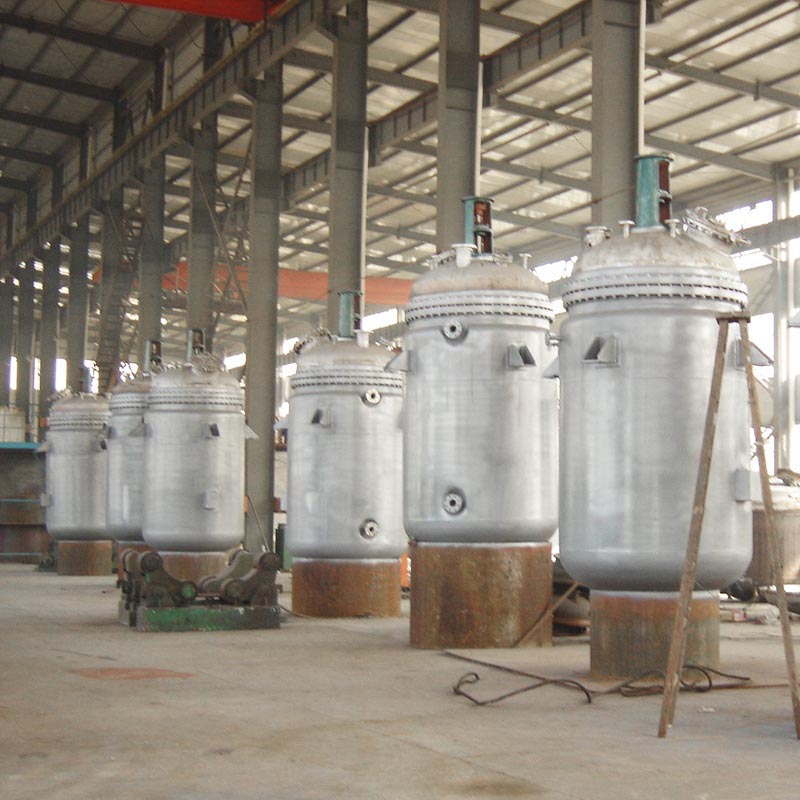
An industrial stirred tank reactor is an integrated system composed of tank body, agitation system, transmission system, and auxiliary systems, each component is designed to meet specific process requirements:
1. Tank Body
- Shape and Dimensions: The main body is a vertical cylindrical structure with a height-to-diameter ratio (H/D) ranging from 1:1 to 4:1, determined by the process requirements (e.g., reaction time, heat transfer area). The top and bottom are usually elliptical or dish-shaped heads to withstand internal pressure and avoid dead zones where materials accumulate.
- Material Selection: The tank body material is selected based on the properties of the processed materials:
- Carbon steel: For non-corrosive materials in general chemical processes;
- Stainless steel (304/316/316L): For food, pharmaceutical and corrosive chemical applications;
- Special alloys (Hastelloy, titanium): For strong corrosive media (e.g., acids, alkalis, halogens);
- Lined materials (PTFE, glass): For high-corrosivity, low-temperature or high-purity requirements.
- Heat Transfer Structure: Jackets or coils are installed on the outside or inside of the tank body to realize heating or cooling of the materials. Steam, thermal oil or cooling water is used as the heat transfer medium, ensuring precise temperature control of the reaction system.
2. Agitation System
The agitation system is the core component determining the performance of the stirred tank, consisting of agitator, shaft and baffle:
- Agitator Types and Applications:
| Agitator Type | Flow Pattern | Key Advantages | Typical Applications |
|---------------|--------------|----------------|----------------------|
| Paddle Agitator | Axial + Radial | Simple structure, low energy consumption | Low-viscosity liquid mixing, solid suspension |
| Turbine Agitator | Radial + Axial | High shear force, excellent dispersion performance | Gas-liquid mixing, liquid-liquid emulsification, solid dissolution |
| Anchor Agitator | Axial + Tangential | Scrape tank wall, no dead zone | High-viscosity fluid mixing, paste processing |
| Helical Ribbon Agitator | Axial | Strong axial circulation, uniform mixing | Ultra-high viscosity materials (e.g., polymer melts, adhesives) |
- Baffles: 3–6 vertical baffles are evenly installed along the tank wall to eliminate the "vortex" phenomenon caused by tangential flow, improve mixing efficiency and ensure uniform fluid distribution. The width of the baffle is usually 1/10–1/12 of the tank diameter.
3. Transmission System
This system provides power for the agitator, including motor, reducer, coupling and shaft seal:
- Motor and Reducer: The motor power is selected based on the material viscosity, tank volume and agitator type. A reducer is used to adjust the agitator speed to the optimal range (typically 10–500 rpm).
- Shaft Seal: It is a critical component to prevent material leakage and external air intrusion. Common types include:
- Mechanical seal: Suitable for high-pressure, high-vacuum or high-purity systems, with excellent sealing performance;
- Packing seal: Simple structure and low cost, suitable for low-pressure and non-toxic material systems.
4. Auxiliary Systems
- Feeding and Discharging System: Includes feed pipes, discharge valves, hoppers and pumps, designed according to the material state (liquid, solid, gas).
- Measurement and Control System: Equipped with temperature sensors, pressure gauges, pH meters and level meters to monitor process parameters in real time. The system can be connected to a PLC for automatic control of agitation speed, temperature and feeding rate.
- Safety System: Includes pressure relief valves, explosion-proof devices and emergency discharge ports to ensure safe operation under abnormal conditions.
Key Selection Guidelines for Stirred Tank Reactors
Selecting the right stirred tank reactor requires comprehensive consideration of material properties, process requirements and industrial application scenarios, following these core principles:
1. Material Property Analysis
- Viscosity: The most critical factor determining the agitator type. Low-viscosity fluids (<100 mPa·s) are suitable for turbine or paddle agitators; medium-viscosity fluids (100–10,000 mPa·s) can use anchor agitators; ultra-high viscosity fluids (>10,000 mPa·s) require helical ribbon agitators.
- Corrosivity and Abrasiveness: Corrosive materials require stainless steel or lined tanks; abrasive materials (e.g., mineral slurries) need wear-resistant linings (e.g., rubber, ceramic) and sturdy agitator shafts.
- Phase State: For gas-liquid systems, select agitators with high gas dispersion performance (e.g., turbine agitators); for solid-liquid systems, prioritize agitators that can prevent particle sedimentation (e.g., paddle agitators with large blades).
2. Process Requirement Matching
- Temperature and Pressure: High-pressure reactions require pressure-resistant tank bodies and mechanical seals; high-temperature reactions need jackets with thermal oil heating; low-temperature reactions require cooling coils and insulation layers.
- Mixing Uniformity: For processes requiring high uniformity (e.g., pharmaceutical synthesis), select agitators with strong axial circulation and install sufficient baffles; for simple mixing processes (e.g., water dilution), paddle agitators can meet the requirements.
- Batch vs. Continuous Operation: Batch stirred tanks are suitable for small-scale, multi-variety production (e.g., pharmaceutical R&D); continuous stirred tanks are preferred for large-scale, single-variety production (e.g., chemical polymerization).
3. Scale-up Considerations
When scaling up from laboratory-scale to industrial-scale stirred tanks, the following principles should be followed to ensure consistent process performance:
- Maintain the same agitator tip speed to ensure consistent shear force;
- Keep the height-to-diameter ratio (H/D) of the tank body unchanged to maintain similar fluid flow patterns;
- Adjust the motor power according to the cube of the tank diameter to compensate for the increase in material volume.
Typical Industrial Applications
Stirred tank reactors are widely used in various industries due to their flexible design and strong adaptability:
1. Chemical Industry
The largest application field of STRs, used for polymerization reactions (e.g., polyethylene, polyvinyl chloride), esterification reactions (e.g., polyester synthesis) and neutralization reactions (e.g., acid-alkali neutralization). Industrial-scale chemical stirred tanks can reach a volume of thousands of cubic meters, equipped with efficient turbine agitators and heat transfer jackets.
2. Pharmaceutical and Biotechnology Industry
Used for drug synthesis, fermentation processes and vaccine production. The tanks are made of stainless steel 316L to meet GMP standards, with sanitary mechanical seals and CIP (clean-in-place) systems to ensure product purity. Anchor agitators are commonly used for high-viscosity pharmaceutical formulations, while turbine agitators are used for microbial fermentation.
3. Food and Beverage Industry
Applied in the production of sauces, dairy products, beverages and food additives. For example, stirred tanks are used for mixing tomato sauce, emulsifying ice cream mixtures and dissolving sugar syrups. The tanks are made of food-grade stainless steel, with smooth inner walls to avoid material adhesion and facilitate cleaning.
4. Environmental Protection and Water Treatment Industry
Used for wastewater treatment (e.g., activated sludge process), flocculation precipitation and chemical dosing. Large-volume stirred tanks are equipped with low-speed paddle agitators to mix flocculants with wastewater uniformly, improving the sedimentation efficiency of suspended solids.
Conclusion
Stirred tank reactors are one of the most widely used process equipment in modern industry, with their performance directly determined by the rational design of the agitation system and the precise matching of process parameters. By comprehensively analyzing material properties, process requirements and scale-up principles, enterprises can select the optimal stirred tank solution to achieve efficient, stable and low-cost production. With the development of intelligent control technology and advanced material science, future stirred tank reactors will move towards the direction of high efficiency, energy saving, intelligence and environmental protection, providing stronger technical support for the upgrading of various industrial fields.