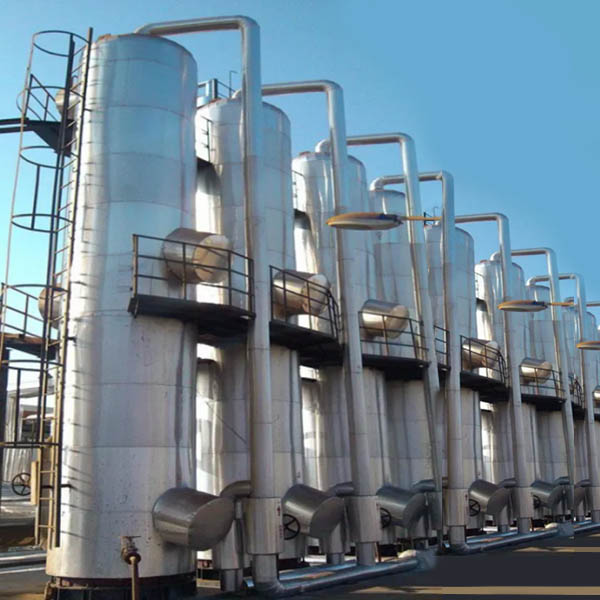
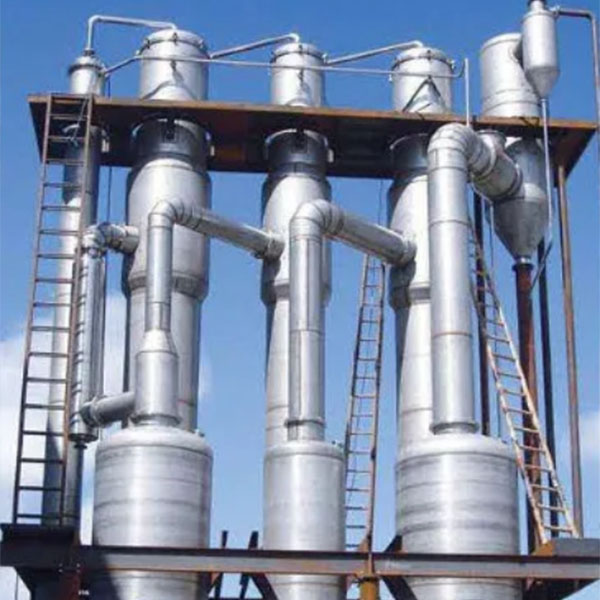
Working Principles of Evaporative Crystallizers
Evaporative crystallizers achieve solid-liquid separation by removing solvents from solutions through thermal evaporation, increasing solute concentration to reach a supersaturated state, and inducing the formation and growth of solid crystals. The entire process consists of four interconnected stages:
1. Feed Pretreatment
Raw solutions (e.g., industrial wastewater, chemical reaction liquors, ore leachates) undergo filtration, pH adjustment, and scale inhibition treatment first. Filtration removes suspended solids that may interfere with crystal growth or block equipment; pH adjustment optimizes the solution environment to prevent the formation of insoluble impurities; anti-scaling agents are added to avoid the deposition of mineral salts on heat exchange surfaces, ensuring stable operation of the crystallizer.
2. Evaporation and Concentration
Pretreated solutions are pumped into the crystallizer’s heat exchange zone, where they are heated by a heat source (steam, thermal oil, or industrial waste heat). Most evaporative crystallizers operate under vacuum conditions, which lowers the solvent’s boiling point, reduces energy consumption, and prevents thermal decomposition of heat-sensitive solutes. As the solvent vaporizes continuously, the solute concentration in the solution increases gradually and approaches the saturation threshold.
3. Supersaturation Induction and Crystal Nucleation
When the solution concentration exceeds the saturation limit, a supersaturated state is achieved. This state is thermodynamically unstable, driving the solute molecules to aggregate and form tiny crystal nuclei—the initial stage of crystal formation. The degree of supersaturation is precisely controlled by adjusting parameters such as evaporation rate, temperature, and stirring speed. Excessively high supersaturation leads to rapid nucleation and the production of fine, irregular crystals, while moderate supersaturation promotes the growth of large, uniform crystals.
4. Crystal Growth and Solid-liquid Separation
The newly formed crystal nuclei are suspended in the supersaturated solution and collide with solute molecules continuously, growing into larger, well-formed crystals under the action of stirring. After reaching the desired crystal size, the crystal-solution mixture (slurry) is discharged into a separation device (centrifuge, filter press, or hydrocyclone). The solid crystals are separated, washed, and dried to obtain the final product, while the mother liquor (remaining solution) is either recycled back to the crystallizer for further concentration or treated as waste according to environmental standards.
Evaporative crystallizers stand out in solid-liquid separation processes due to their unique design and operational advantages, with the following key technical characteristics:
1. High-efficiency Solvent Removal and Crystal Yield
The combination of evaporation and crystallization enables simultaneous solvent recovery and solute purification, achieving crystal yields of 85–98% for most soluble salts and organic compounds. Advanced heat exchange designs (e.g., thin-film evaporation, forced circulation) minimize thermal resistance, ensuring rapid solvent vaporization and high production efficiency.
2. Controllable Crystal Quality
By adjusting process parameters (evaporation rate, stirring intensity, residence time, and seed crystal addition), the crystallizer can precisely control crystal size, shape, and purity. Adding seed crystals of uniform size can guide directional crystal growth, avoiding spontaneous nucleation and producing high-quality crystals that meet industrial-grade or pharmaceutical-grade standards.
3. Strong Adaptability to Complex Feed Solutions
Evaporative crystallizers can handle a wide range of feedstocks, including high-salt wastewater, viscous solutions, and fluids containing trace impurities. Specialized designs (e.g., scraped-surface heat exchangers, anti-fouling coatings) prevent scaling and fouling, ensuring stable operation even for solutions with high scaling tendency (e.g., sodium chloride, calcium sulfate solutions).
4. Energy-saving and Environmentally Friendly Operation
Integrated energy-saving technologies significantly reduce operational costs:
- Multi-effect Crystallization: Connects 2–6 crystallizer units in series, using secondary vapor from the previous effect as the heat source for the next effect, cutting raw steam consumption by 30–70% compared to single-effect systems.
- Mechanical Vapor Recompression (MVR): Compresses low-pressure secondary vapor to increase its temperature and pressure, recycling it as a heat source. MVR crystallizers consume only 1/5–1/3 of the energy of traditional single-effect systems, with near-zero waste steam discharge.
- Waste Heat Utilization: Uses industrial waste heat (e.g., flue gas from boilers, cooling water from reactors) as the heat source, improving overall energy utilization efficiency and reducing carbon emissions.
5. High Degree of Automation and Operational Stability
Modern evaporative crystallizers are equipped with PLC-based intelligent control systems, which monitor and adjust key parameters (temperature, pressure, liquid level, crystal size) in real time. Automated feeding, discharging, and cleaning systems reduce manual intervention, lower labor costs, and ensure consistent product quality even during long-term continuous operation.
Typical Industrial Applications of Evaporative Crystallizers
Evaporative crystallizers are widely used in various industries for solute recovery, wastewater treatment, and product purification, with the following key application scenarios:
1. Chemical Industry
This is the largest application field of evaporative crystallizers, used for the production of inorganic salts (sodium chloride, potassium sulfate, ammonium nitrate) and organic compounds (citric acid, urea, adipic acid). For example, forced-circulation evaporative crystallizers are used to produce high-purity sodium chloride from brine, while DTB (Draft Tube and Baffle) crystallizers are adopted for the production of large, uniform urea crystals. In addition, crystallizers treat chemical wastewater to recover valuable salts, reducing waste discharge and realizing resource recycling.
2. Metallurgical Industry
In hydrometallurgy processes, evaporative crystallizers are used to recover metal salts from ore leachates. For instance, they extract copper sulfate from copper ore leach solutions and nickel chloride from nickel ore leachates. The recovered metal salts are further processed into high-purity metal products, while the treated wastewater meets environmental discharge standards. In the steel industry, crystallizers treat pickling wastewater to recover ferrous sulfate, turning hazardous waste into a marketable by-product.
3. Food and Beverage Industry
Evaporative crystallizers are used for the production of food-grade crystalline products, with strict requirements for hygiene and product purity. They are widely applied in the crystallization of sucrose, glucose, fructose, and monosodium glutamate (MSG). Vacuum evaporative crystallizers are preferred for heat-sensitive food materials, as low-temperature operation preserves the nutritional value and flavor of the products. For example, falling-film evaporative crystallizers concentrate sugarcane juice and induce sugar crystallization, producing large-grain white sugar with high purity.
4. Pharmaceutical Industry
In pharmaceutical production, evaporative crystallizers are used to purify active pharmaceutical ingredients (APIs) and intermediates. The strict control of crystal size and shape ensures the bioavailability and stability of drugs. For example, OSLO-type crystallizers are used for the crystallization of antibiotics and vitamins, producing uniform crystals that meet GMP (Good Manufacturing Practice) standards. Crystallizers also treat pharmaceutical wastewater to recover organic solvents and reduce COD levels, helping enterprises comply with strict environmental regulations.
5. Environmental Protection and Wastewater Treatment
Evaporative crystallizers play a vital role in the treatment of high-salt industrial wastewater (e.g., electroplating wastewater, textile printing and dyeing wastewater, landfill leachate). They evaporate water from the wastewater, concentrating salts and heavy metals into solid crystals, which are either recycled or disposed of safely. The reclaimed water can be reused in industrial production, realizing closed-loop water circulation and reducing fresh water consumption. For example, MVR evaporative crystallizers treat electroplating wastewater to recover nickel sulfate and copper sulfate, while producing reclaimed water that meets the standards for rinsing processes.
6. Mining and Mineral Processing Industry
In the mining sector, evaporative crystallizers process brine resources to extract valuable minerals such as lithium carbonate, potassium chloride, and magnesium sulfate. For example, in lithium battery raw material production, crystallizers concentrate lithium-containing brine and induce lithium carbonate crystallization, providing high-purity raw materials for the new energy industry. This application not only realizes the development of mineral resources but also promotes the sustainable development of the new energy sector.