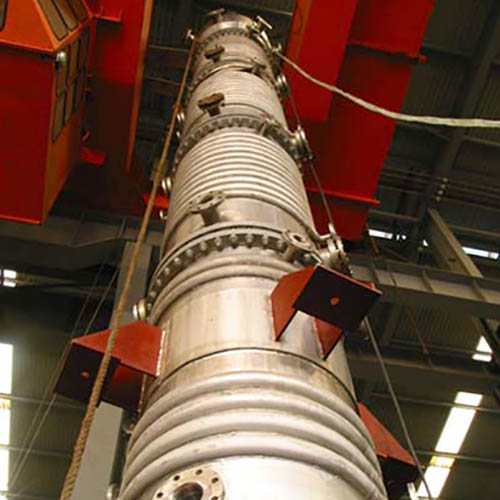
Extraction Equipment (Extractor): Working Principles, Common Types, and Selection Guide
Release time:2026-04-17
Visits:229
Extraction equipment, often referred to as extractors, are key mass transfer devices used in industrial production to separate liquid-liquid or solid-liquid components. By promoting sufficient contact between two phases and utilizing the distribution characteristics of substances in different phases, they efficiently separate target components from raw materials. These devices are widely applied in chemical engineering, petroleum, nuclear industry, environmental protection, and other fields. Understanding the working principles, common types, and selection methods of extraction equipment is crucial for improving production efficiency and separation effectiveness.
I. Working Principles of Extraction Equipment
The core working logic of
extraction equipment is based on the ""distribution coefficient difference"": different substances form a distribution equilibrium in two immiscible (or slightly miscible) solvents due to differences in solubility. Simply put, when raw materials come into contact with a specific solvent, the target substance tends to dissolve in the solvent, while other components remain in the raw material phase, thereby achieving separation. For example, in chemical production, by selecting a solvent with higher solubility for the target product, it can be ""extracted"" from complex raw materials to complete initial separation.
II. Common Types of Extraction Equipment
Based on structural and operational differences, extraction equipment can be categorized into the following types, each suitable for different production scenarios:
1. Mixer-Settler
The mixer-settler is the most commonly used stage-wise contact extraction equipment in industry, consisting of two parts: a ""mixing chamber"" and a ""settling chamber.""
- Mixing Chamber: Equipped with a stirring device, it thoroughly mixes raw materials and solvent through agitation, facilitating the transfer of target substances from the raw material phase to the solvent phase.
- Settling Chamber: The mixed liquid enters the settling chamber, where the two phases naturally separate due to density differences. The upper layer is the light phase (solvent phase), and the lower layer is the heavy phase (raw material phase), achieving initial separation.
Mixer-settlers have a simple structure and stable operation, making them suitable for large processing volumes and scenarios with low requirements for separation precision.
2. Extraction Column
The extraction column is a continuous contact mass transfer device that increases the contact area and contact time between two phases through internal packing (e.g., packed columns) or specially designed plates (e.g., sieve tray columns, pulsed columns), thereby improving extraction efficiency.
- Liquid enters from the top of the column, and gas or another liquid phase is introduced from the bottom. They flow countercurrently inside the column, making sufficient contact, and target substances are transferred to the solvent phase through mass transfer.
Extraction columns occupy small floor space and are suitable for continuous production processes with high requirements for separation efficiency.
3. Centrifugal Extractor
The centrifugal extractor accelerates phase separation using centrifugal force, making it a highly efficient and rapid extraction device.
- The internal part of the device generates strong centrifugal force through high-speed rotation, enabling the two phases with different densities to separate in a short time, significantly reducing separation time.
Centrifugal extractors are particularly suitable for processing materials with small density differences that are difficult to separate naturally, or scenarios requiring high separation speed, such as the separation of radioactive substances in the nuclear industry.
III. Key Design and Selection Considerations for Extraction Equipment
Selecting appropriate extraction equipment requires comprehensive consideration of production requirements and material characteristics. The following are key selection factors:
1. Raw Material Properties
The phase state (liquid/solid), viscosity, density, and impurity content of raw materials directly influence the choice of equipment type. For example, high-viscosity raw materials may require stronger agitation or centrifugal force to assist mixing and separation.
2. Distribution Coefficient of Target Product
The distribution coefficient (the ratio of the target substance's concentration in the solvent phase to that in the raw material phase) determines extraction efficiency. A higher distribution coefficient indicates easier separation, allowing priority selection of simple-structured equipment (e.g., mixer-settlers); for lower distribution coefficients, equipment with larger contact areas (e.g., extraction columns) is needed.
3. Processing Capacity and Production Scale
Small-scale batch production can use flexible mixer-settlers, while large-scale continuous production is better suited for extraction columns or centrifugal extractors to meet efficient and continuous processing requirements.
4. Operating Conditions
Operating conditions such as temperature and pressure affect solvent solubility and phase separation speed. For example, high-temperature environments may require equipment made of heat-resistant materials to prevent solvent volatilization or equipment damage.
Summary
Extraction equipment is a core tool for material separation. Its working principle is based on distribution coefficient differences, completing target substance extraction through three key steps: mixing, contact, and separation. Mixer-settlers, extraction columns, and centrifugal extractors are three common types, each with applicable scenarios. In practical applications, comprehensive selection based on raw material properties, product characteristics, and production scale is necessary to achieve optimal separation效果 and provide efficient support for industrial production."