Ethanol Distillation Column: A Detailed Explanation of Key Equipment for Efficient Separation and Purification of Ethanol
Release time:2026-03-20
Visits:294
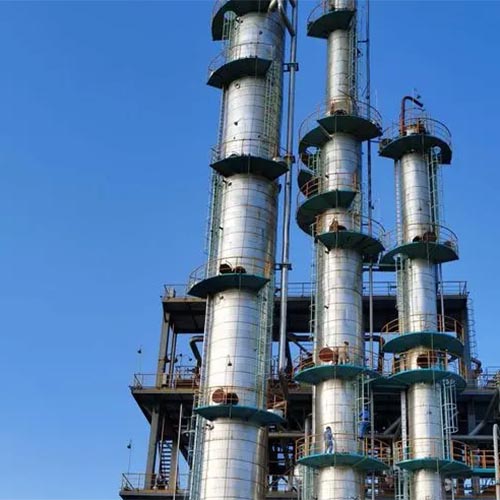
As an indispensable key equipment in chemical production, the ethanol distillation column plays a crucial role in the separation and purification process of ethanol. It skillfully utilizes the difference in boiling points between different substances and achieves efficient separation and purification of ethanol from liquid mixtures through a series of precise physical processes, providing high-purity ethanol raw materials for numerous industrial fields.
Working Principle of Ethanol Distillation Column
The core working principle of an ethanol distillation column lies in separating substances based on their different boiling points. Its main working process includes the following key steps:
1. Heating and Evaporation: The ethanol mixture to be separated is first introduced into the bottom area of the
distillation column. Here, the mixture is heated by heating devices such as a reboiler. When the temperature reaches the boiling points of the components in the mixture, components with lower boiling points, such as ethanol, first absorb heat and vaporize into steam.
2. Ascent and Gas-Liquid Exchange: The vaporized steam, due to its lower density than liquid, naturally flows upward and rises along the interior of the distillation column. During the ascent, this steam comes into full contact with the liquid reflux (usually partially condensed product) descending from the top of the column on the trays or specially designed packing layers.
3. Condensation and Reflux: On the trays or packing layers, the ascending steam and descending liquid undergo close heat and mass exchange. The high-boiling components in the steam, upon encountering the relatively low-temperature liquid, release heat and condense into liquid, flowing downward again; while the low-boiling components (mainly ethanol) in the liquid absorb heat and continue to vaporize into steam moving upward. This process repeats continuously, causing the ethanol concentration in the ascending steam to become increasingly high.
4. Product Collection and Purification: After multiple gas-liquid exchanges and separations within the column, the ethanol-rich steam finally reaches the top of the column. The condenser at the top of the column cools these high-concentration ethanol vapors, causing them to condense into a liquid state. A portion of the condensed liquid is collected as the final purified ethanol product; another portion is returned to the top of the column as reflux to maintain stable operation and separation efficiency within the column, ensuring the continuous obtainment of high-purity ethanol.
Design Considerations for Ethanol Distillation Column
Designing an efficient and economical ethanol distillation column requires comprehensive consideration of several key factors to ensure its optimal performance:
Optimization of Feed Position: The selection of the feed position is a critical aspect in distillation column design. It needs to be comprehensively determined based on the compositional characteristics of the feedstock to be separated (such as ethanol concentration, impurity types, etc.), the structure and number of trays (or the type and height of packing) inside the column, and the expected operating conditions (such as temperature, pressure). The ideal feed position should allow the raw material to be added at a region within the column where the concentration and temperature distribution are most suitable to achieve the best separation effect.
Ensuring Separation Efficiency: The feed position has a direct and significant impact on the separation efficiency of the distillation column. If the feed position is too high, it may cause light components (ethanol) in the raw material to reach the top of the column prematurely before being fully separated, thereby reducing product purity and separation efficiency; conversely, if the feed position is too low, it may cause the raw material to stay at the bottom of the column for too long, increasing the heat load of the reboiler, resulting in higher energy consumption, and may also affect the separation effect.
Balancing Operational Flexibility and Economy: When determining the feed position and other design parameters, full consideration should also be given to the operational flexibility of the distillation column, that is, the ability of the column equipment to adapt to changes in raw material composition, processing capacity, etc., within a certain range. At the same time, energy consumption costs and initial equipment investment are also important considerations. It is necessary to seek the optimal balance between operating costs and investment costs under the premise of ensuring separation efficiency to achieve the economic feasibility of the entire distillation process.
Wide Application Fields of Ethanol Distillation Column
Ethanol distillation columns, relying on their efficient separation and purification capabilities, are widely used in multiple industrial fields:
Pharmaceutical Industry: In pharmaceutical production processes, ethanol is often used as a solvent or extractant. Ethanol distillation columns are used to recover and purify ethanol generated in the process, ensuring that it can be recycled or meet specific purity requirements, which is crucial for ensuring drug quality and reducing production costs.
Chemical Industry: In chemical production, ethanol is an important raw material or solvent for many chemical reactions. Ethanol distillation columns can efficiently separate ethanol from water and other organic impurities, meeting the diverse needs of different chemical processes for ethanol concentration and purity, and are key unit operation equipment in numerous chemical processes.
Food Industry: In the field of food processing, ethanol is sometimes used for the extraction and refinement of food additives or the treatment of certain specific flavor components. Ethanol distillation columns can be used to purify and recover ethanol used in these processes, ensuring that it meets food-grade safety standards and achieving effective utilization of resources.
In summary, ethanol distillation columns, through their ingenious design and application of physical and chemical principles, achieve efficient separation and purification of ethanol. Their design and operation require comprehensive consideration of multiple factors such as raw material characteristics, separation requirements, energy consumption, and economy to ensure that the equipment can operate long-term, stably, and efficiently, providing high-quality ethanol products for various related industries."