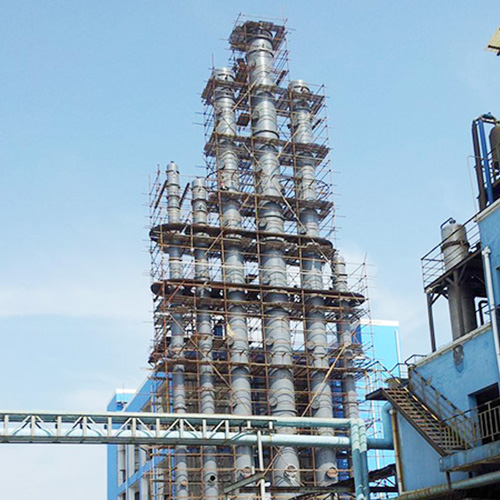
Distillation towers—also referred to as distillation columns or fractionating columns—are foundational unit operations in chemical engineering, designed to separate multicomponent mixtures into purified fractions based on differences in relative volatility (a function of boiling points and vapor pressure). Governed by principles of vapor-liquid equilibrium (VLE) and mass transfer, these vertically oriented structures enable precise separation of liquids, gases, or liquid-gas mixtures, making them indispensable across industries requiring high-purity feedstocks, intermediate products, or end-use commodities. This article systematically outlines the core industrial applications of distillation towers, technical nuances of their operation, key design considerations, and modern advancements, emphasizing their role in driving process efficiency and product quality.
1. Technical Fundamentals: How Distillation Towers Operate
At their core,
distillation towers facilitate fractional distillation—a continuous separation process optimized for mixtures with overlapping boiling points. The technical workflow relies on three critical mechanisms:
- Vaporization: A reboiler at the tower base heats the feed mixture, vaporizing the more volatile (lower boiling point) components.
- Vapor-Liquid Contact: Vapor rises through the tower, interacting with a descending liquid stream (reflux) across trays (e.g., sieve, bubble-cap, valve trays) or packing materials (e.g., structured packing like Mellapak, random packing like Raschig rings). This contact enables mass transfer: volatile components transfer from liquid to vapor, while less volatile components condense back into the liquid phase.
- Condensation & Fractionation: Vapor ascends through successive stages (theoretical plates), becoming increasingly enriched in volatile components. At the tower top, a condenser cools and condenses the vapor into a distillate. Less volatile components (bottoms product) are collected at the base, with intermediate fractions (side draws) extracted at specific heights corresponding to their boiling points.
Key design parameters include reflux ratio (L/V, liquid-to-vapor flow rate), number of theoretical plates, feed tray location, and tower diameter/height—all optimized via process simulation software (e.g., Aspen Plus, HYSYS) to balance purity, energy efficiency, and capital cost.
2. Core Industrial Applications
Distillation towers are deployed across diverse sectors, each leveraging their separation capabilities to meet industry-specific purity, scalability, and regulatory requirements:
2.1 Petrochemical & Oil Refining Industry
The petrochemical sector is the largest user of distillation towers, where they form the backbone of crude oil refining and hydrocarbon processing.
- Crude Oil Distillation: Atmospheric distillation towers (1–2 atm pressure, 350–400°C) separate crude oil into fractions such as naphtha (C5–C12, boiling range 30–200°C), kerosene (C12–C15, 200–300°C), diesel (C15–C20, 300–370°C), and atmospheric gas oil (AGO). Vacuum distillation towers (0.01–0.05 atm) further process heavy residues (e.g., vacuum gas oil, VGO) at lower temperatures (350–450°C) to avoid thermal cracking, producing lubricating oils and feedstocks for catalytic cracking units.
- Hydrocarbon Upgrading: Towers are used to purify products from downstream processes, such as reforming (naphtha to high-octane gasoline), hydrocracking (heavy oils to diesel), and ethylene production (steam cracking of naphtha/ethane, followed by distillation to separate ethylene, propylene, and butadiene—key monomers for plastics).
- Regulatory Compliance: Meets API (American Petroleum Institute) standards (e.g., API 620 for pressure vessels) and EPA emissions requirements by minimizing volatile organic compound (VOC) losses during separation.
2.2 Chemical Manufacturing Industry
Chemical production relies on distillation towers for feedstock purification, intermediate separation, and solvent recovery—critical for ensuring product consistency and meeting ISO 9001 quality standards.
- Bulk Chemicals: Production of methanol, ethanol, ethylene glycol, and ammonia requires distillation to purify synthesis products from unreacted feedstocks and byproducts. For example, methanol synthesis (CO + H₂ → CH₃OH) uses distillation towers to achieve 99.8%+ purity by removing water and higher alcohols.
- Specialty Chemicals & Polymers: Separation of monomers (e.g., styrene, vinyl chloride) and oligomers to ensure polymer chain uniformity; purification of catalysts and additives for pharmaceutical, automotive, and electronics applications.
- Solvent Recovery: Distillation towers recover solvents (e.g., acetone, toluene, hexane) from process waste streams, reducing raw material costs and environmental impact—compliant with EPA’s Resource Conservation and Recovery Act (RCRA).
2.3 Pharmaceutical & Fine Chemical Industry
In pharmaceutical manufacturing, distillation towers enable ultra-high-purity (99.9%+) separation, critical for meeting FDA (U.S. Food and Drug Administration) and EMA (European Medicines Agency) regulations for drug safety and efficacy.
- Active Pharmaceutical Ingredient (API) Purification: Fractional distillation (often under vacuum to avoid thermal degradation) separates APIs from reaction intermediates, catalysts, and impurities. For example, distillation of ethanol used in drug formulations to achieve USP (United States Pharmacopeia) grade (99.5%+ purity).
- Solvent Purification: Recovery and purification of GMP (Good Manufacturing Practices)-compliant solvents (e.g., methanol, isopropanol) to prevent cross-contamination in batch processing.
- Chiral Separation: Specialized distillation (e.g., extractive distillation with chiral solvents) for separating enantiomers (mirror-image molecules) in pharmaceutical intermediates—essential for avoiding toxic side effects (e.g., thalidomide enantiomer separation).
2.4 Food & Beverage Industry
Distillation towers are used in controlled, regulatory-compliant processes to produce alcoholic beverages and food-grade ingredients, adhering to FDA and international food safety standards (e.g., Codex Alimentarius).
- Alcoholic Spirits: Production of whiskey, vodka, rum, and gin involves fractional distillation of fermented mash (grain, fruit, or molasses) to concentrate ethanol (boiling point 78.3°C) and separate it from water, congeners (flavor compounds), and impurities. Column stills (continuous distillation) enable higher ethanol concentrations (up to 95% ABV) compared to pot stills, with precise control over flavor profiles.
- Food Additives: Purification of food-grade ethanol (for flavor extracts, preservatives) and glycerol (for sweeteners, emulsifiers) via distillation to remove toxic contaminants (e.g., methanol) and ensure compliance with FDA 21 CFR Part 173.
2.5 Environmental & Waste Management Industry
Distillation towers play a key role in sustainable waste treatment and resource recovery, aligning with UN Sustainable Development Goal 12 (Responsible Consumption and Production) and EPA emissions regulations.
- VOC Recovery: Distillation (often combined with condensation or adsorption) recovers VOCs (e.g., benzene, trichloroethylene) from industrial exhaust streams and wastewater, preventing atmospheric pollution and enabling reuse of valuable chemicals.
- Wastewater Treatment: Distillation towers treat high-strength industrial wastewater (e.g., from chemical plants, refineries) to separate salts, heavy metals, and organic contaminants, producing reusable water (meets EPA Clean Water Act standards) and concentrated waste for safe disposal.
- Biofuel Production: Separation of biodiesel (fatty acid methyl esters, FAME) from glycerol byproduct via distillation, ensuring biodiesel meets ASTM D6751 or EN 14214 standards for use in transportation fuels.
2.6 Other Emerging Applications
- Renewable Energy: Distillation of biogas (methane + CO₂) to remove CO₂ and impurities, producing pipeline-quality renewable natural gas (RNG) compliant with ISO 13686.
- Electronics Manufacturing: Purification of high-purity solvents (e.g., isopropyl alcohol, acetone) for cleaning semiconductor wafers and electronic components, meeting SEMI (Semiconductor Equipment and Materials International) standards for ultra-low particle counts.
- Mining & Metallurgy: Recovery of solvents (e.g., cyanide, leachates) from mineral processing streams, reducing environmental impact and lowering operational costs.
3. Key Components & Design Considerations
Distillation tower performance is dictated by its components and design parameters, tailored to the mixture’s properties and separation goals:
| Component | Technical Function |
|---------------------|-----------------------------------------------------------------------------------|
| Reboiler | Heats the bottoms stream to generate vapor; types include kettle, thermosiphon, and forced-circulation reboilers (selected based on viscosity and fouling tendency of the mixture). |
| Condenser | Cools overhead vapor to liquid; total condensers (for pure distillate) or partial condensers (for vapor-liquid splits) are used, with cooling media (water, refrigerants) selected for temperature requirements. |
| Trays/Packing | Trays (e.g., sieve trays for high throughput, valve trays for flexibility) or packing (structured packing for high efficiency, random packing for low pressure drop) provide vapor-liquid contact surface area. |
| Reflux Drum | Stores condensed distillate, recycling a portion (reflux) back to the tower to enhance separation; equipped with level controls to maintain steady reflux ratio. |
| Feed Distributor| Ensures uniform distribution of the feed mixture across the tower cross-section, preventing channeling (uneven vapor-liquid flow) and maximizing mass transfer efficiency. |
Critical design factors include:
- Mixture Properties: Relative volatility, viscosity, corrosiveness, and thermal stability (e.g., heat-sensitive mixtures require vacuum distillation).
- Purity Requirements: Number of theoretical plates and reflux ratio (higher purity demands more plates and higher reflux, increasing energy consumption).
- Energy Efficiency: Integration with heat exchangers (e.g., heat integration between distillate and feed streams) or advanced technologies (heat pump distillation, dividing-wall columns) to reduce energy use by 30–50%.
- Scalability: Tower diameter (0.5–10+ meters) and height (10–100+ meters) scaled to production capacity (lab-scale columns <1 meter tall to industrial-scale towers for 100,000+ barrels/day crude oil refining).
4. Advantages, Challenges, & Modern Advancements
4.1 Core Advantages
- High Purity: Achieves separation efficiencies up to 99.99% for volatile mixtures, unmatched by many alternative technologies (e.g., filtration, extraction).
- Versatility: Handles diverse mixtures (polar/non-polar, organic/inorganic, liquid/gas) across temperature (-50°C to 500°C) and pressure (vacuum to 100+ atm) ranges.
- Scalability: Adaptable to lab-scale R&D, pilot plants, and large-scale industrial production with consistent performance.
- Cost-Effectiveness: Lower operational costs for high-volume separations compared to membrane filtration or crystallization, especially with energy recovery systems.
4.2 Key Challenges
- Energy Intensity: Traditional distillation accounts for 10–15% of global industrial energy consumption, primarily due to reboiler and condenser heat requirements.
- Thermal Degradation: Heat-sensitive compounds (e.g., pharmaceuticals, biofuels) may degrade at high temperatures, requiring vacuum or low-temperature distillation.
- Fouling & Corrosion: Mixtures containing solids, polymers, or corrosive components (e.g., acids, salts) can foul trays/packing or corrode tower materials (mitigated via alloy construction, e.g., Hastelloy, Inconel, or periodic cleaning).
- Capital Cost: Large-scale towers (e.g., crude oil distillation columns) require significant upfront investment in engineering, fabrication, and installation.
4.3 Modern Advancements
- Energy-Efficient Designs: Dividing-wall columns (DWC) reduce energy use by 20–30% by integrating two separation stages into a single tower; heat pump distillation recovers waste heat from condensers to power reboilers.
- Advanced Materials: Ceramic or composite packing for corrosive environments; 3D-printed trays for optimized vapor-liquid contact and reduced fouling.
- Digitalization & AI: Real-time monitoring via IoT sensors (temperature, pressure, liquid levels) and AI-driven process optimization (e.g., machine learning models to adjust reflux ratio and feed rate) to minimize energy consumption and maximize purity.
- Sustainable Separations: Hybrid processes (distillation + membrane filtration) for difficult separations; use of renewable energy (solar, geothermal) to power reboilers, reducing carbon footprint.
5. Conclusion
Distillation towers are irreplaceable in modern industrial processes, enabling precise separation across sectors ranging from petrochemical refining to pharmaceutical manufacturing. Their ability to deliver high-purity products, scalability, and versatility makes them a cornerstone of chemical engineering, while ongoing advancements in energy efficiency and digitalization address historical challenges of energy intensity and complexity.
As industries transition toward sustainability and circular economy principles, distillation towers will play an increasingly critical role in resource recovery, waste reduction, and low-carbon manufacturing. Whether refining crude oil into transportation fuels, purifying APIs for life-saving drugs, or recovering solvents from industrial waste, these engineering marvels remain essential to meeting global demand for high-quality, compliant products.
For engineers, plant operators, and industry stakeholders, understanding the industrial applications and technical nuances of distillation towers is key to optimizing processes, reducing costs, and achieving regulatory compliance—reinforcing their status as a timeless and indispensable technology in the industrial landscape.