Advanced Turbine-Agitated Extraction Columns: Principles, Design Optimization, and Industrial Applications
Release time:2026-05-12
Visits:9
Introduction
The
Turbine-Agitated Extraction Column (commonly referred to as the Turbine Extraction Tower or Column, such as the Kühni column) represents a sophisticated class of stage-wise liquid-liquid extraction equipment. It is extensively utilized in chemical, pharmaceutical, and hydrometallurgical industries where high separation efficiency, flexibility, and continuous operation are paramount. Unlike simple gravity-driven columns, this device employs mechanical agitation to intensively mix two immiscible liquid phases, thereby maximizing the interfacial area for mass transfer.
Structural Configuration and Working Principle
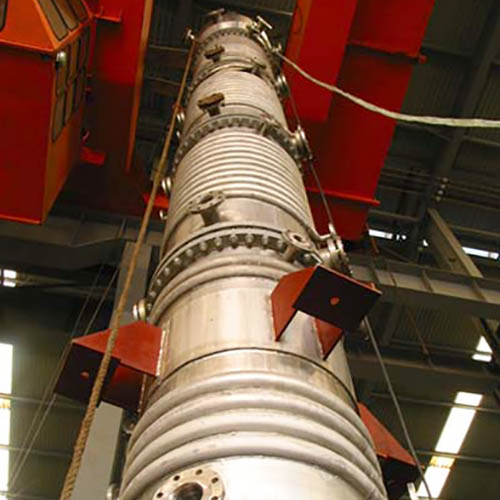
The column typically consists of a vertical cylindrical shell divided into multiple compartments by horizontal perforated plates (partition plates). A central shaft runs axially through the column, fitted with turbine impellers (or agitators) positioned in the center of each compartment.
The operational mechanism relies on counter-current flow:
• The heavy phase generally enters the top and flows downward.
The light phase enters the bottom and flows upward.
• As the turbines rotate, they create a torus-shaped, high-shear flow pattern. This disperses the discontinuous phase into fine droplets within the continuous phase, drastically increasing the interfacial area for solute transfer.
The perforated plates serve dual purposes: they act as settling zones allowing coalescence and phase separation, and they minimize back-mixing between compartments, which preserves the concentration gradient and enhances stage efficiency.
Key Design Parameters and Optimization
The performance of a turbine extraction column is highly dependent on its geometric and operational variables. Engineers can optimize these parameters to suit specific physicochemical properties of the process streams:
Turbine Geometry: The diameter and type of the impeller (e.g., open vs. closed turbine) significantly influence hydrodynamics. Research indicates that closed turbines offer stronger suction-discharge actions, leading to more uniform holdup distribution and 10–15% higher mass transfer efficiency compared to open turbines in certain systems.
Compartment Geometry: The height of the compartments and the open area (porosity) of the perforated plates are critical. Optimizing tray porosity (e.g., around 35%) and turbine diameter relative to the tower diameter is essential for balancing throughput and extraction rate.
Operational Variables: Rotation speed (RPM) is a primary control parameter. Increased speed generally improves droplet breakup and mass transfer until an optimum point is reached where excessive energy input might cause stable emulsification or high entrainment. Phase ratios and temperature also play vital roles in determining the overall mass transfer coefficient.
Performance Characteristics and Advantages
The turbine-agitated column offers several distinct advantages over conventional packed or spray columns:
High Stage Efficiency: Each compartment behavesly as a theoretical stage, allowing for sharp separations. Columns can be designed to achieve more than 30 theoretical stages in a single unit.
Flexibility and Turndown: The column handles varying process parameters, phase ratios (up to 70:1), and physical properties (low density differences >40 kg/m³, viscosities up to 2 mPa·s or higher) effectively. It typically offers a standard turndown ratio of 1:3.
Scalability: Due to the defined compartment structure and predictable flow patterns, scaling up from pilot plants to industrial diameters (ranging from 30 mm to 3.5 m) is relatively reliable compared to other dynamic columns.
Advanced Modifications and Applications
To further enhance performance, modifications such as the Pulsed Kühni Column (PKC) have been developed. Introducing mild pulsation alongside mechanical agitation has been shown to double the throughput while maintaining excellent operational stability.
Industrially, these columns are pivotal in:
• Pharmaceuticals: Separation and purification of antibiotics (e.g., Lincomycin), where extraction rates above 99.0% are achievable.
Petrochemicals: Separation of aromatics, alkane processing, and natural gas desulfurization.
Environmental Engineering: Treatment of phenolic wastewater and recovery of heavy metals from industrial effluents.
Conclusion
The turbine-agitated extraction column stands as a robust, efficient, and adaptable solution for complex liquid-liquid separation tasks. Through precise mechanical design and operational control, it addresses the limitations of passive extraction equipment, offering superior mass transfer rates and flexibility crucial for modern industrial separation processes.